
Camping Tent Size Guide: How to Match Capacity Ratings to Your Real-World Group
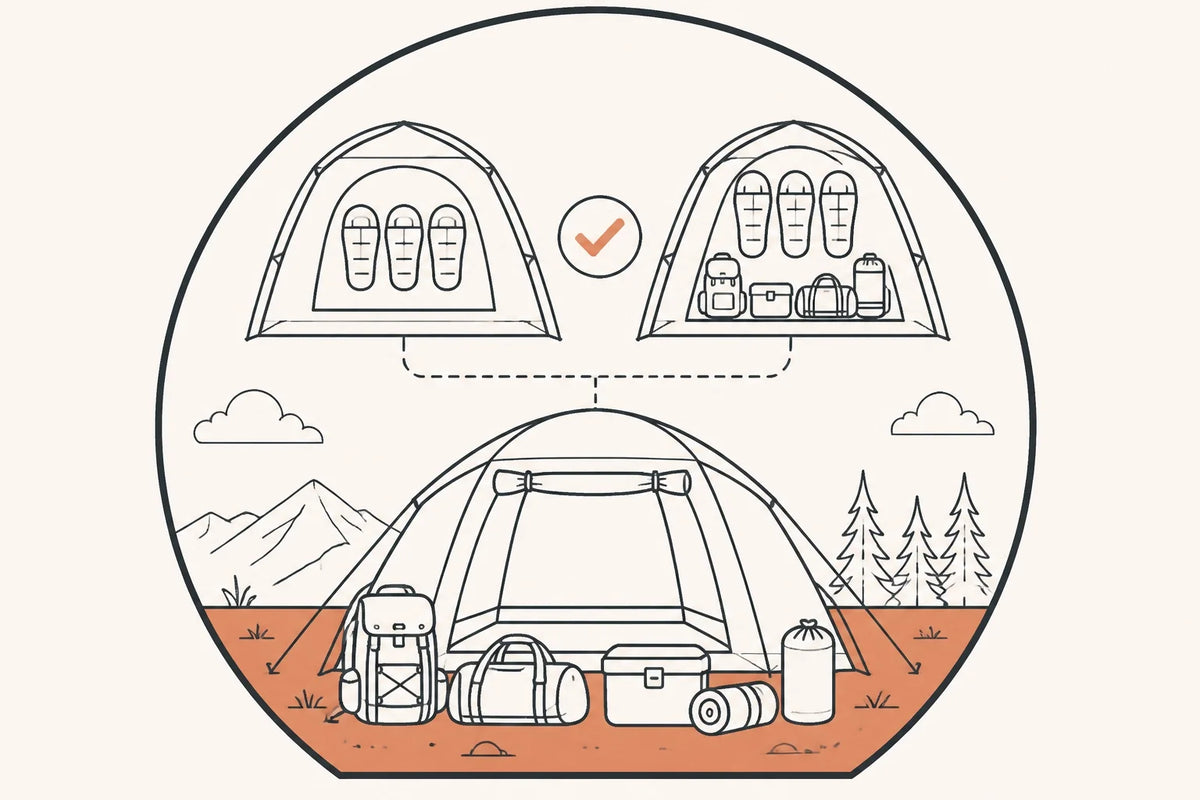
You finally pull up to the campsite after a long drive, excited to set up your brand-new four-person camping tent. But when you crawl inside, something feels off. Four people? You can barely stretch out alongside one other adult without your sleeping bags overlapping. Sound familiar?
Here's the thing: tent manufacturers and real-world campers are speaking completely different languages when it comes to capacity ratings. That number printed on the box? It describes the absolute minimum floor space needed to lay bodies side by side, with zero wiggle room, zero gear, and zero comfort. It was never meant to reflect how normal humans actually sleep outdoors.
The good news is that once you understand how capacity ratings actually work, shopping for the right tent gets a whole lot easier. In this guide, you will learn the simple "subtract one" rule that experienced campers swear by, how to read floor area and peak height specs like a pro, why vestibule space is a total game-changer, and how to match tent size to your specific trip type and group. No more guessing, no more squished sleeping bags.
Why Tent Capacity Ratings Are Not What You Think
That number on the tent box is not a comfort rating. It is a geometry exercise.
Manufacturers calculate capacity by counting how many standard sleeping mats (51 cm wide) fit side by side across the inner floor with zero gaps and nothing else inside. No packs, no boots, no sleeping bag loft. Just mats, edge to edge.
That math ignores sitting space, movement room, and gear storage entirely. It also assumes everyone uses a narrow 51 cm mat. Most campers today use wider self-inflating pads, roughly 63 cm across. A standard 3-person tent floor is approximately 153 cm wide, which fits exactly three narrow mats. Three wide mats would need 189 cm, more than the typical "3-person" floor provides, so that tent realistically sleeps two people on wide pads.
The frustration is legitimate, and it is widespread. The fix starts with understanding what the capacity number actually measures: a minimum-space floor-packing calculation, not a livability promise. Once you see it that way, you will check the tent specifications and floor dimensions first, and trust the headline number a lot less.
The Subtract One Rule: Your New Default for Any Tent for Camping
Now that you know why the numbers are inflated, here's the fix: subtract one.
Take whatever capacity is printed on the box and drop it by one person. That is your real, comfortable sleeping number. Experienced campers do this automatically, and outdoor retailers apply the same logic when helping customers choose.
Here is how it plays out in practice, based on common camper experience rather than a published industry standard:
A camping tent rated for 2 people comfortably sleeps one adult with gear, or two adults traveling ultralight with minimal kit.
A camping tent 4 person rating comfortably fits two adults with normal gear, or three adults if packs get stored outside.
A camping tent 6 person rating becomes a solid five-person tent, or a genuinely roomy option for four people on a gear-heavy trip.
If you are camping with kids, pets, or anyone who values personal space, consider dividing the rated number roughly in half. That is not being overly cautious; it is a completely legitimate comfort strategy.
The most important habit: apply this rule before you look at price or weight. Once you reframe a "4-person tent" as a 2-to-3-person tent, every comparison changes. You stop shopping for the wrong size, which is far and away the most common and most punishing tent-buying mistake beginners make.
Floor Area Per Person: The Spec That Actually Tells You What Fits
Once you know to subtract one from the rated capacity, the next question is: how tight is tight, exactly? Floor area gives you a real number to work with.
Find the square footage listed in the specs and divide it by your actual group size. A comfortable benchmark used by experienced campers is roughly 25 to 30 square feet (2.3 to 2.8 sq m) per adult with gear inside (your own comfort threshold may vary). Experienced campers often find anything under 15 to 20 sq ft per person uncomfortably tight, fine for an ultralight overnight but miserable on a rainy day when nobody's leaving the tent.
For a reminder of how mat widths translate to rated floor width, see the section above.
Adult shoulder width, plus sleeping bag loft, consistently eats into usable floor width beyond what bare measurements suggest, so always treat bare floor dimensions as a ceiling, not a guarantee.
When browsing at Adventure Cove Store, large family tents like this one include full floor dimensions in the specs tab. Use those numbers, not the headline capacity, as your primary filter.
Peak Height and Headroom: Why Vertical Space Is Not Optional
Floor area tells you what fits horizontally. But once a rainstorm rolls in and everyone is stuck inside for two hours, the number that actually determines your comfort is peak height, and capacity ratings say nothing about it.
A peak below about 3.5 feet (107 cm) makes sitting upright difficult for most adults, try pulling on a jacket or changing out of wet clothes and you will immediately feel why that number matters. It is not a dealbreaker for a single clear-sky overnight, but it becomes one fast on any real trip.
Peak height alone can also mislead you. What matters equally is how that height is distributed across the floor. A-frame and tunnel designs stack most of their vertical space along a narrow central ridge; the walls slope away steeply on either side, shrinking the area where you can actually sit or move. Cabin-style tents use nearly vertical walls, keeping usable headroom consistent across a much larger portion of the floor.
For backpacking, lower peak height is a reasonable trade-off for weight savings. The Naturehike Mongar 2 Person Tent is ideal for situations where you are prioritizing packed weight over in-tent livability. For car camping with family or a group, many car campers find 5 to 6 feet (150 to 180 cm) comfortable for dressing and moving around.
One last thing to check: confirm whether the listed peak height is measured at the center ridge or at a point within the actual usable interior. Those two numbers are not always the same.
Vestibule Space: The Feature That Can Save Your Floor Area
Vestibule space shapes how the whole campsite functions, and for multi-night trips it matters just as much as vertical headroom.
A vestibule is the covered area between the inner tent and the outer fly, essentially a mudroom. It adds zero sleeping capacity but completely changes how livable your tent feels after day one.
Here is why: manufacturer capacity ratings assume you sleep with your gear inside the tent. Shove two large packs, muddy boots, and wet rain jackets onto the inner floor and a roomy tent becomes a tight squeeze fast. A proper vestibule moves all of that outside the sleeping area, reclaiming floor space the rating never accounted for.
For a 4-person rated tent used by two adults on a weekend trip, a decent vestibule is often the difference between genuinely comfortable and constantly shifting around someone's duffel bag. You get the same total usable space without paying for a larger tent.
A practical size benchmark: useful vestibule space fits two large backpacks side by side with enough clearance to crouch and retrieve gear without crawling fully inside. Check the full specifications tab on any tent listing, since vestibule dimensions are often listed separately from inner floor area, often in square feet or as a secondary footprint measurement.
Treat vestibule size as a required field, not a bonus feature, for any trip beyond a single overnight.
Couples and duos benefit most here. For many couples, a two-person tent with a generous vestibule can match the usable space of a three-person tent without one, worth checking the specs before sizing up.
Picking the Right Size: A Practical Guide by Trip Type
Now that you understand the rules, here is how they map to real trips.
Solo backpacker, 1-3 nights: Go with a camping tent rated for 2 people. That gives you room for your sleeping bag, a small pack, and enough space to roll over without elbowing a tent wall. True 1-person tents save weight but tend to feel oppressive by night two.
Couples car camping, 1-2 nights with moderate gear: A 4-person rated tent is the right call. The Subtract One Rule lands you at comfortable 3-person space, which means two adults plus gear without navigating an obstacle course at 2 a.m.
Couples or pairs on multi-night trips with full gear: Either a 4-person tent with a solid vestibule or a 5-person tent with a smaller vestibule. The extra floor area earns its keep starting on night three, when everyone's stuff has expanded to fill every corner.
Family of 4, car camping: A 6-person rated tent is the realistic floor. Kids create more movement chaos than their small frames suggest, and four people generate a surprising amount of gear.
Large groups or multi-family trips: A 12-person tent works as a communal hub, but two 6-person tents is usually the smarter split. Easier to set up, better airflow, and if one family bails, you are not hauling an empty cathedral home.
Festivals or casual overnights with packs in the car: This is the one situation where you can ease off the Subtract One Rule. With minimal gear inside, rated capacity is close to real-world capacity.
How Weather and Seasons Should Shift Your Size Decision
Trip type gets you close, but weather is the variable that can make a correctly-sized tent feel suddenly wrong.
In fair weather, the Subtract One Rule is enough. Doors stay open, gear lives outside, and nobody is trapped inside for hours. The math works.
Wet and variable conditions change everything. If you're camping anywhere with afternoon thunderstorms, coastal rain, or unpredictable summers, subtract one additional person beyond the standard rule. You need room for wet jackets piled in a corner, condensation wiped off walls, and two people sitting upright killing time during a two-hour downpour.
Cold-weather camping shrinks your floor faster than you'd expect. A bulky four-season sleeping bag, a thick insulated sleeping pad, and a pile of layered clothing take up real estate. A rated-4 tent can feel genuinely tight for just two cold-weather sleepers once all that gear is spread out.
Hot and humid conditions flip the priority entirely. More mesh beats more square footage here. Look at interior mesh panel placement and window positions alongside floor dimensions; airflow determines sleep quality more than raw space.
Four-season tents have steeper, more vertical sidewalls designed to shed snow loads. That geometry reduces usable sitting space near the tent edges, so account for that during extended weather events when you're living inside rather than just sleeping.
Tent Capacity Quick-Reference: Rated vs. Real-World
All the context above helps narrow down one tent for every scenario. Here's the whole picture in one place.
The mappings below reflect common camper experience rather than a published industry standard, apply the same judgement you would to the Subtract One Rule covered above.
Rated Capacity |
Comfortable Real-World Use |
|---|---|
2-person tent |
1 adult with full gear; or 2 adults on ultralight trips with minimal kit |
4-person tent |
2 adults with normal car-camping gear; or 3 adults with packs stored in a vestibule |
6-person tent |
4-5 adults; or a family of 4 with kids and full camping gear |
12-person tent |
8-10 adults with gear; or a communal/mess tent when everyone has a separate sleeping shelter |
If you're browsing at Adventure Cove Store and the table still leaves you uncertain, run the floor area check: a comfortable benchmark used by experienced campers is roughly 25 to 30 square feet per adult (your own comfort threshold may vary). Divide the listed floor area by your actual group size, and the math will tell you the truth fast.
Still on the fence? Size up by one. The price gap between a 4-person and 6-person tent is almost always smaller than the cost of a miserable, sleepless night for your whole group.
Before You Buy: What to Check Every Time
Use this checklist every time before you commit to a tent.
Apply the Subtract One Rule first, covered in detail above.
Then run the floor area check, divide total square footage by your actual group size using the per-adult benchmark described in the Floor Area Per Person section above.
Check peak height and headroom distribution, refer to the vertical space guidance above to confirm usable clearance for your group.
Confirm vestibule capacity, as covered in the Vestibule Space section above, treat this as a required spec for any trip beyond a single overnight.
Finally, match the tent to your trip type, run it through the trip-type and weather framework covered earlier in this guide, since a camping tent 6 person or 12 person tent that works perfectly for a car camping weekend may be completely wrong for a stormy multi-night trip.
Adventure Cove Store lists complete floor dimensions and vestibule specs for every tent. Browse the full product specifications and use those real numbers, not the headline capacity, to make your call.
Conclusion
Tent capacity ratings are a starting point, not a guarantee. The real work is in the math: subtract one from the rated capacity, confirm floor area per person, check usable headroom, and verify vestibule storage before committing to any purchase.
Get those four steps right and you eliminate the most common camping mistakes before they happen. You stop paying for space that sounds good on a label but disappears the moment real people and real gear move in.
The right tent does not just fit your group. It protects your trip when weather turns, keeps morale high on long nights inside, and gives everyone enough room to actually rest.
Use the real specs at Adventure Cove Store to run your numbers today. Your next camping trip deserves a tent sized for how you actually camp, not how a manufacturer counts sleeping bags.