
Pedal Kayak vs. Paddle Kayak for Fishing: Which Drive System Catches More Fish?
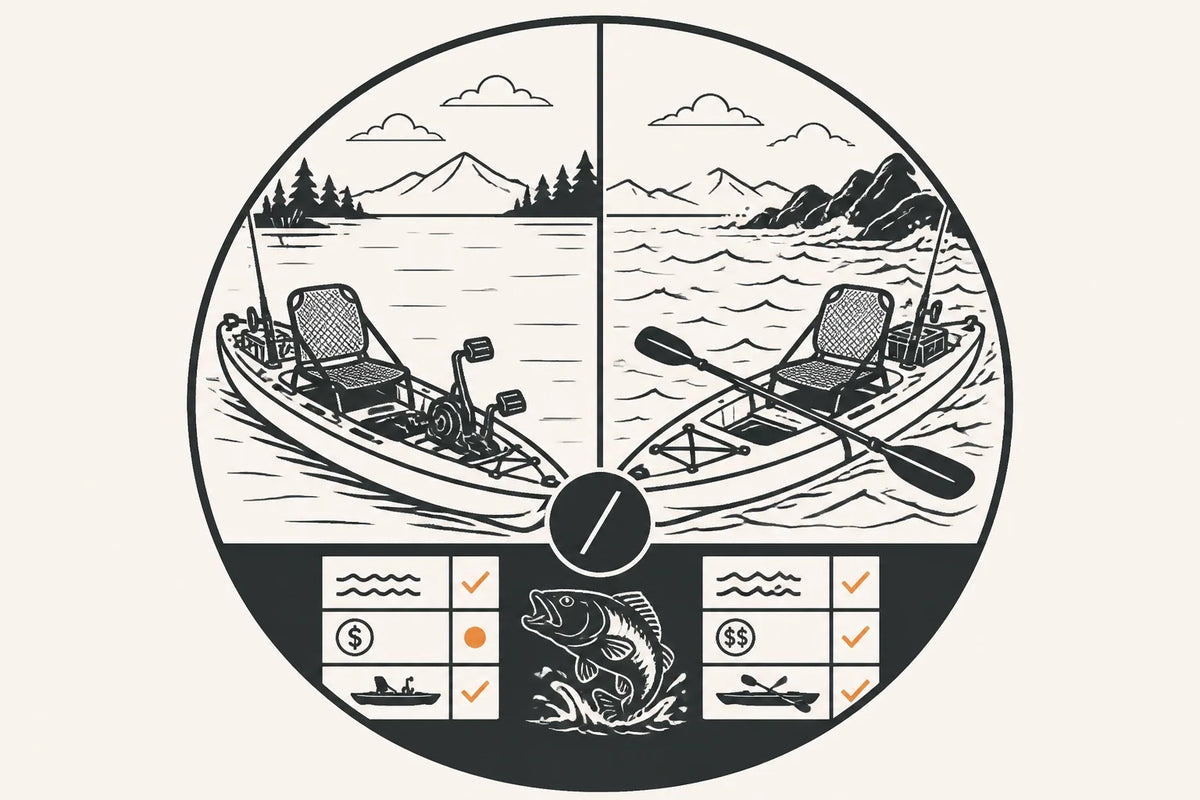
Picture this: you've just spotted a bass holding tight against a fallen log, but the moment you reach for your rod, your kayak starts drifting off course. Now you're juggling a paddle, fighting the current, and watching that fish disappear. Sound familiar?
This is exactly the kind of frustration that turns so many anglers toward a pedal fishing kayak. But is pedal drive actually worth it, or is a simple paddle kayak the smarter choice for your situation?
The honest answer is that it depends, and that's what this guide is all about. We're going to skip the spec-sheet comparisons and focus on what actually matters on the water: keeping your hands free to cast, reaching the skinny shallows where big fish hide, staying fresh after a long day, and spending your money wisely. We'll walk through everything from drive system types and hull stability to weight, transport, safety, and how to match your setup to the water you actually fish. By the end, you'll know exactly which drive system fits your fishing life.
The Hands-Free Advantage: Why Pedal Drive Changes How You Fish
Picture this: you're drifting a current seam, your lure is working perfectly along the edge, and a bass slams it. Your hands are already on the rod because your feet never stopped holding your position. That moment is the clearest argument for a pedal fishing kayak.
Pedal-drive systems hand you back both arms for every part of the catch, from the first cast to the final landing. No scrambling to stow a paddle, no fumbling for a rod holder while a fish runs. Your hands stay where they belong.
That advantage compounds in moving water. When current is pushing your hull, a paddle angler has to choose between steering and fishing. On a pedal kayak, your feet manage the drift while your hands keep the lure in the strike zone. That's a real fishing outcome, not just a convenience.
Fatigue matters too. Pedaling relies on your lower body, leaving your casting arm and shoulders fresher over a long day on the water.
One honest note: no published data directly compares catch rates between pedal and paddle kayaks. The edge is situational. Pedal drive creates conditions more favorable to catching fish by keeping you in position and hands-ready; it doesn't guarantee results.
If you want a versatile starting point, this modular paddle-drive kayak built for fishing combines both worlds in a single hull.
Where Paddle Kayaks Still Win: The Shallow Water Reality
That hands-free advantage is real, but it comes with a hard tradeoff depending on where you fish.
Pedal-drive systems need roughly 13 inches of clearance below the hull to operate. On open lakes or deeper rivers, that is a non-issue. On tidal flats, shallow grass beds, or skinny backcountry creeks, it is a trip-ender. Drag the prop through the mud once and you are either stuck or facing a repair bill.
A paddle fishing kayak draws far less water than any pedal system, letting you ease into grass, lily-pad fields, and tidal skinny water that a pedal drive simply cannot reach. For sight-casting on saltwater flats or shallow reservoir back-ends, that access advantage is decisive. You cannot catch fish in water you cannot reach.
Some pedal systems close the gap slightly. Fin-type drives are designed to handle bottom contact better than fixed props, making them a common choice for anglers who fish varied or weedy terrain. Retractable systems add versatility by letting you stow the drive unit and switch to a paddle when depth drops. The next section covers all three pedal-drive subtypes in detail.
Neither workaround matches the true shallow draft of a paddle-only hull. If shallow water is your primary fishing environment, a paddle kayak is the better tool.
Not All Pedal Systems Are the Same: Fixed Prop, Retractable, and Fin Drives
Those shallow-water limitations come down to which pedal system you have under your hull, and they are not all built the same.
Fixed-prop systems are optimised for open, deeper water where propeller clearance is never an issue, but they leave the angler with no workaround in skinny water. Rocks, weeds, and shallow ramps are genuine hazards, and a hard strike can damage the prop or drive housing.
Retractable systems add versatility by letting you stow the drive unit and switch to a paddle when depth drops. You lose pedal propulsion in that mode, but you gain a functional paddle kayak as a backup. For anglers who cross a mix of depths in a single trip, that flexibility is genuinely useful rather than just a nice-to-have.
Fin-type drives are designed to handle bottom contact better than fixed props, making them a common choice for anglers who fish varied or weedy terrain. If you regularly fish grass flats, rocky creeks, or varied terrain, this design handles incidental bottom contact far better than a fixed prop. You can check power fin drive specifications to see how the mechanics differ in practice.
A simple rule: open deep water suits fixed props, mixed-depth fisheries suit retractable props, and weedy or rocky shallows suit fin drives. All three cost more than a comparable paddle kayak, so this decision comes after you have already decided the pedal premium is worth it.
Stability and Hull Behavior: Standing to Cast vs. Tracking Straight
Beyond which pedal system you choose, the hull itself shapes how your fishing day actually goes.
Pedal-drive fishing kayaks are normally wider than paddle kayaks. That extra beam is not accidental; it accommodates the drive unit below deck and creates a stable platform wide enough to stand on while sight-casting. If you regularly stand to spot fish in clear water before making a cast, that stability is a genuine on-water advantage, not just a marketing claim.
The trade-off is tracking. The wider beam that aids standing stability can make the kayak more responsive to wind and current, something pedal control helps manage but still requires attention in open or breezy conditions. On a calm pond that barely registers, but on a breezy open lake or a tidal flat with any push to it, you will find yourself making constant corrections just to keep your bow pointed where you want it and your lure drifting naturally.
Paddle kayaks carry narrower, lower-profile hulls that hold a straighter line with less effort. The drawback is less initial stability for standing. For anglers who cast seated the majority of the time, that narrower platform is completely adequate across typical fishing conditions. Loading and transport implications of that extra beam are covered in the next section.
Weight, Transport, and Launch Logistics
That wider, heavier build feeds directly into a real-world headache: getting the kayak to the water.
Pedal-drive kayaks are generally heavier than comparable paddle models, a real consideration when loading solo. That penalty is most noticeable when loading onto a car roof or hauling down a steep, rocky bank. A paddle fishing kayak you can manage alone is a genuine advantage, especially if you fish mid-week without help.
Many pedal drive units can be separated from the hull for transport and storage, check the model you're considering, but reassembly at the launch adds steps to your morning routine. Before you push off, run through these every time:
Drive unit fully seated and locked in the hull
Rudder moving freely and responding correctly
Cable tension checked with no slack or fraying
Always bring a backup paddle on every trip, regardless of drive system. If a drive unit fails mid-lake, that paddle is your only way back to shore. Treat it as essential safety gear, not optional cargo. You can see how a well-designed sit-on-top fishing kayak includes paddle storage as part of its standard setup.
For anglers who fish remote sites, hike-in launches, or travel regularly between fisheries, paddle kayaks reduce the physical and logistical load considerably. Less to carry means fewer reasons to skip a session.
Price, Budget, and Getting Real Value From Your Investment
Weight and transport costs are real, but for most buyers, price is where the decision actually lands.
Both paddle and pedal fishing kayaks span roughly the same range, from just over $1,000 up to $5,000 or $6,000. The difference is what you get at each price point. With a pedal kayak, a meaningful portion of your budget goes toward the drive mechanism rather than hull features, storage, or rigging. A paddle kayak at the same price often comes better equipped out of the box.
For weekend anglers hitting a small local lake, that premium rarely pays off in proportion to the extra cost. A well-outfitted paddle fishing kayak handles those conditions just fine, and the money saved can go toward quality rods, electronics, or safety gear.
The math shifts on bigger water. Long days on coastal bays, large river systems, or multi-mile reservoir stretches are exactly where the pedal investment earns its keep. The hands-free advantage and extended range compound over a full session in ways that short weekend trips simply never reveal.
Also factor in ongoing costs. Pedal drive systems do have more moving parts than a paddle setup, so factor in the likelihood of occasional maintenance when calculating total ownership cost. Paddle kayak upkeep is minimal, mostly hull inspection and hatch care.
Adventure Cove stocks both paddle and pedal fishing kayaks across price tiers, plus essential safety gear including life vests, dry bags, and paddle floats. Buying your full setup together typically saves money and ensures nothing important gets skipped.
Matching Your Drive System to Your Fishery
Budget narrows the field, but your fishery makes the final call.
Rivers and tidal creeks are where pedal kayaks earn their price tag most convincingly. Holding position against moving current while keeping both hands on a rod is genuinely difficult with a paddle. Your feet handle the work, your hands stay free, and your lure stays in the strike zone longer.
Shallow freshwater flats, back-bays, and grass ponds flip that equation. Pedal drives need at least 13 inches of water to run safely. Push into skinnier water and you risk dragging bottom, fouling the drive, or snapping off the unit entirely. A paddle kayak has no such limit and can ease into inches-deep grass without drama.
Large lakes and open reservoirs sit in the middle. Pedal kayaks let you cover more water with less arm fatigue across a long day. Paddle kayaks are perfectly capable if you anchor near structure and fish tight. Session length and personal preference drive this one more than any technical advantage.
Saltwater inshore fishing in mixed depths is the strongest argument for a retractable or fin-drive pedal system. One boat handles deep channels and shallow flats on a single trip.
The fishery matchups above should give you a clear starting point before the final decision section. If you enjoy exploring paddle-powered water sports more broadly, paddleboarding is another great option worth considering.
On-Water Safety for Kayak Anglers: What Your Drive System Does Not Change
Some safety rules apply to every angler on every outing, regardless of drive system.
Wear your PFD every single time. The U.S. Coast Guard reports 87% of drowning victims were not wearing a life jacket. Low-profile fishing PFDs sit close to the body, give full casting range of motion, and keep you afloat if you capsize.
Carry baseline signaling and communication gear. A whistle, a waterproof light for early-morning or late-evening fishing, and a waterproof phone case or VHF radio for coastal trips weigh almost nothing and matter enormously if something goes wrong.
Pedal kayak anglers: keep a backup paddle strapped where you can reach it instantly, drive units can fail mid-lake.
Practice re-entry before you need it. Rehearsing how to right and re-board your hull in shallow, calm water is far easier than learning mid-river in cold water.
File a float plan any time you fish alone. Tell someone your launch site, planned route, and expected return time. This applies to a two-hour bass pond session just as much as a full-day coastal run.
In cold water or rough conditions, layering under your PFD adds critical protection. A men's waterproof breathable kayak dry suit or a men's three-layer waterproof kayak rescue kit provides a thermal barrier if you end up in the water unexpectedly.
So, Which Drive System Should You Choose?
With safety covered, the only thing left is the decision itself.
Pedal fishing kayaks are worth the premium if you fish moving water, run long sessions, or need both hands free for casting and boat control. They create better fishing conditions by keeping you positioned and ready. They do not guarantee more fish, but they stack the odds in your favor on bigger, more demanding water.
Paddle kayaks are the stronger pick for very shallow fisheries, solo anglers handling transport alone, and anyone who wants a capable, no-fuss setup without the extra cost. For a small local lake or a portable fishing trip on a tight budget, a well-outfitted paddle kayak gets the job done.
If you are still unsure, answer three questions:
What depth do you fish most often? Under 13 inches means paddle wins.
How long are your typical sessions? Half-day paddles are fine; full-day river runs favor pedal.
What is your realistic total budget, including safety gear? Pedal systems cost more at every price tier.
Adventure Cove stocks fishing kayaks, life vests, and fishing accessories so you can build a complete, safe setup in one place. Browse the store or reach out if you want a hand narrowing down your options.
Conclusion
Choosing between a pedal kayak and a paddle kayak comes down to where you fish, how long you fish, and what you can realistically spend. Pedal drives deliver a genuine hands-free advantage on bigger water and longer sessions. Paddle kayaks remain the smarter, more practical choice for shallow fisheries and budget-conscious anglers. Neither system replaces skill, preparation, or proper safety gear.
The right kayak is the one that fits your actual fishery, not the flashiest option on the market.
Ready to build your setup? Adventure Cove carries fishing kayaks, life vests, and angling accessories to get you fully equipped from day one. Browse the store today, pick the system that matches your water, and spend less time second-guessing your gear. More time on the water means more opportunities to catch fish.